

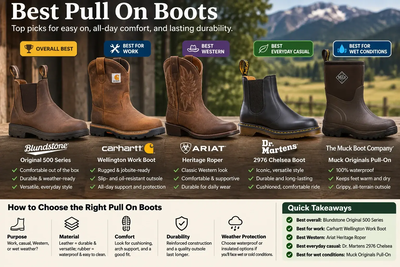
If you've ever wrestled with frozen laces at 5 a.m. or tried to kick off mud-caked hiking shoes after a long shift, you already know why pull on boots exist. They offer quick and easy wear, eliminate the need for laces or buckles, and still deliver the protection, support, and durability that serious outdoor use demands. This guide breaks down the best pull-on boots across every category-work, hiking, casual, and foul-weather duty-so you can find the right pair without wading through hundreds of random product pages.
How We Chose the Best Pull-On Boots
Key Criteria We Focused On
- Performance and support – Traction on wet floors, mud, and uneven ground. Shank design for arch stability. Ankle support when carrying packs or tools, including climbing stairs with a load.
- Comfort for long wear – Cushioned insoles minimize foot fatigue during long shifts. We evaluated arch support systems, break in period expectations, weight per boot, and how each model feels after 8–12 hours on your feet.
- Weather protection – Waterproof work boots keep feet dry in wet conditions. We compared sealed membranes, neoprene insulation thickness, and breathability in hot weather.
- Durability and construction – Construction quality affects the long-term durability of boots. We prioritized high-quality materials like full grain leather, rubber overlays, and welt construction over cheaper cemented builds. Goodyear welt construction allows resoling for long-term repairability.
- Fit and ease of use – How easy boots are to pull on and off, heel hold, and availability of wide sizes. Pull-on boots accommodate foot swelling during long hours, which matters for workers on extended shifts.
- Safety and terrain – Steel toe boots provide maximum protection against crushing injuries. Composite toe boots are lighter than steel toe options. We checked for electrical hazard protection ratings, slip resistance certifications, and outsole lug patterns suited to mud, rock, or city streets.
- Value for money – We prioritized boots that justify their current price through real-world lifespan and performance. A boot you can resole after two years beats a cheap pair that falls apart in six months.
Best Pull-On Boots for Work, Hiking & Everyday Use
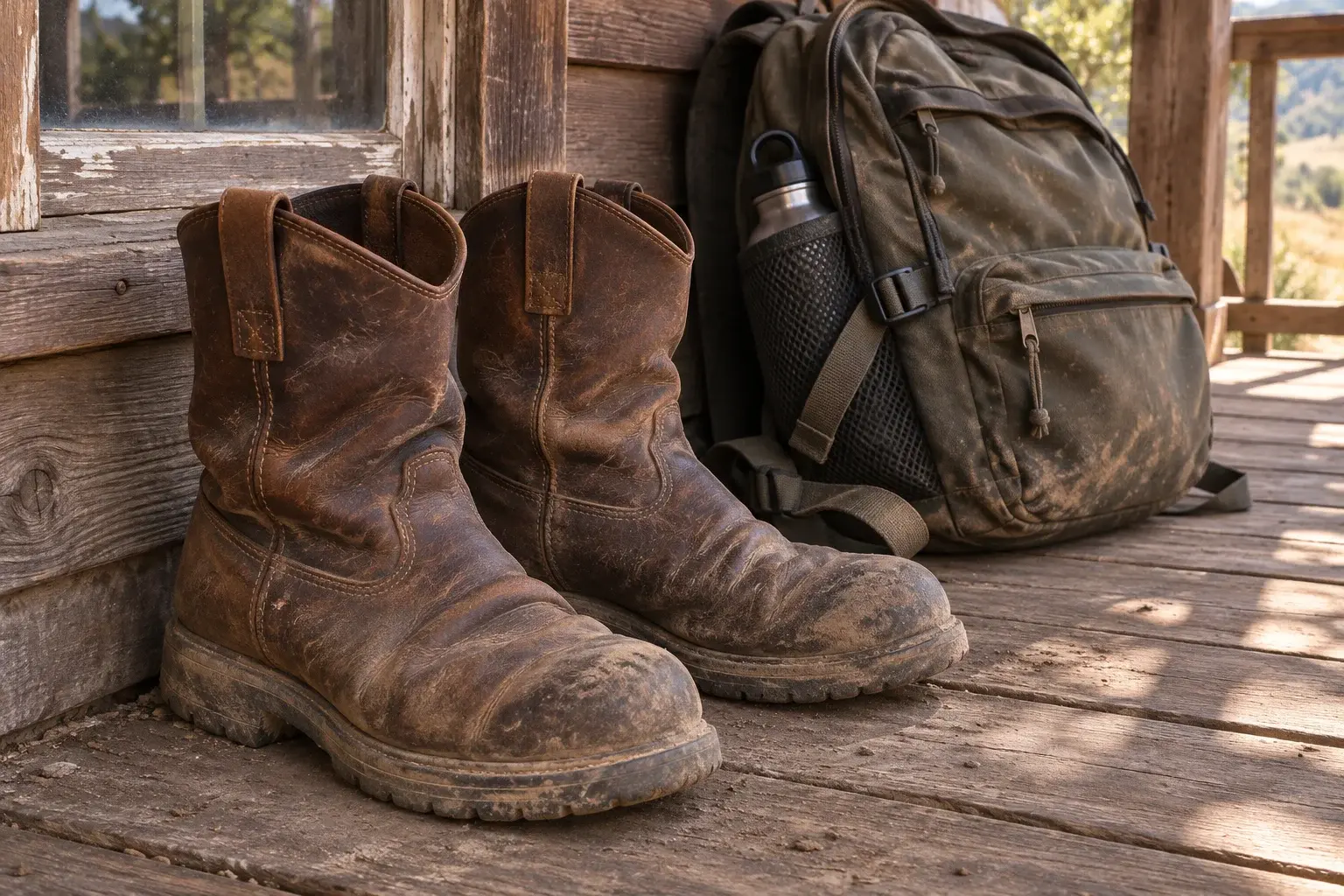
Our research supports a focused list of seven boots representing distinct categories: heavy-duty work, farm and ranch, wet and muddy conditions, all-day standing, cold-weather duty, Western style, and lightweight trail use. Every recommendation links to widely available models on Amazon or major retailers in 2026.
Ariat WorkHog Pull-On Work Boot – Best Overall Pull-On Work Boot
The WorkHog is the boot that most trades reach for when they want a pull-on that can survive daily abuse on concrete, packed dirt, and rough job sites. Its combination of ATS Max support, a tall 10-inch leather shaft, and Duratread outsole puts it at the top of our list for all-around work use.
Why It Stands Out
The ATS Max platform delivers side-to-side stability that makes this boot surprisingly sure-footed on ladders and uneven ground. Oil- and slip-resistant rubber outsoles enhance traction on slick surfaces-the Duratread outsole passes hot-contact tests at 300°C (572°F) and meets ASTM F3445 for slip resistance. Safety features such as steel toes are available, along with composite toe and electrical hazard rated versions. Full grain leather provides durability in this pull-on work boot, and the six-row stitch pattern on the Goodyear welt means you can expect years of hard wear before needing a resole.
Best For
- Construction workers and tradespeople on concrete or packed dirt who need an all-day work boot without laces.
- Farm and ranch users who move between barn, truck, and pasture.
- Anyone wanting one boot that handles both job sites and general outdoor chores.
Key Strengths
- Excellent arch and heel support for long work hours standing or walking.
- U-Turn Entry System helps high-instep wearers slip in easier-solves a common pull-on frustration.
- Optional waterproof leather (H2O version) and safety toe variants for wet or hazardous work sites.
- Removable Pro Performance insoles that can be swapped for custom orthotics.
Possible Limitations
- Heavier and warmer than casual pull-on boots; not ideal for light summer wear.
- The taller shaft may feel bulky if you're used to low-cut hikers or Chelsea style footwear.
Blundstone 550 Series – Best Pull-On Boots for Everyday & Travel
The Blundstone 550 is the boot that travels well. Chelsea boots can balance everyday style with outdoor capability, and the 550 does exactly that-moving from airports to campgrounds to city streets without looking out of place.
Why It Stands Out
Out-of-the-box comfort with minimal break in is the 550's calling card. The shock-absorbing midsole provides cushioning without bulk, and the elastic-sided design traces back to the original Victorian elastic-gusset boot patented in 1837. Composite toe boots are airport friendly, and while the standard 550 is soft toe, Blundstone offers safety toe versions in related lines for those who need toe protection at work.
Best For
- Travelers and van-lifers who need one pair for airports, campsites, and towns.
- Campers and day hikers on moderate trails, gravel roads, and around camp. For even lighter options, check our guide to lightweight camping shoes.
Key Strengths
- Very easy on/off with twin pull tabs and elastic sides.
- Lightweight compared to most work-oriented pull-on boots.
- Works with jeans or casual office outfits-high "wear it everywhere" factor.
Possible Limitations
- Not fully waterproof; handles drizzle and damp grass but not standing water or deep mud.
- Less ankle support and underfoot protection than heavy-duty work boots or logger boots.
Muck Boot Chore Classic – Best Pull-On Boots for Mud & Wet Conditions
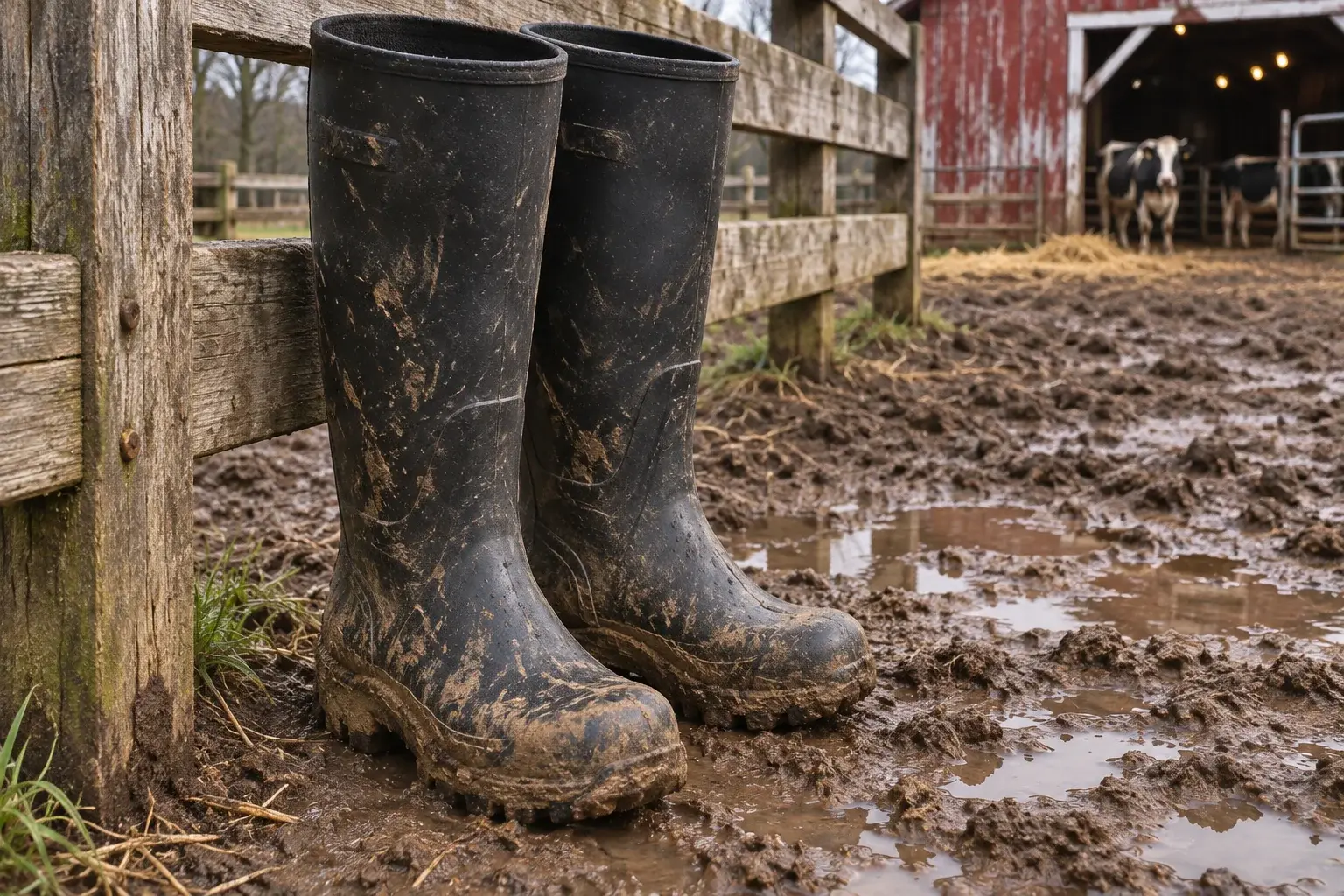
When your job or campsite involves ankle-deep muck, manure, or flooded ground, the Chore Classic is the boot that earns its keep. Waterproof work boots keep feet dry in wet conditions, and nothing does that more reliably than a rubber-neoprene pull-on built specifically for the worst of it.
Why It Stands Out
The Chore Classic features a rubber overlay bonded to a 5 mm neoprene bootie with breathable Airmesh lining. Waterproof boots use sealed membranes to block water, and this boot takes that further with triple-reinforced toe and quadruple-reinforced heel areas. A steel shank provides arch support through long days in soggy fields. Waterproof boots are essential for outdoor workers in wet climates, and this model's quick-clean outsole sheds mud efficiently.
Best For
- Farmers, homesteaders, and hunters dealing with mud, manure, and wet fields.
- Campers who expect rainy seasons, swampy access roads, or spring melt.
Key Strengths
- 100% waterproof construction; easy to hose off after filthy jobs.
- Tall shaft that sheds water, mud, and debris better than any lace-up boot.
- Reliable traction in sloppy barnyards, wet grass, and shallow streams.
- Customer ratings average around 4.4 out of 5 with over 81% recommending the boot.
Possible Limitations
- Too warm and sweaty for hot summer hiking or indoor work. Rubber traps heat.
- Bulky material and style-not suited to office or casual city wear.
Redback Bobcat Elastic-Sided Boots – Best Pull-On Boots for Standing All Day
If your day means long hours on concrete or shop floors, the Redback Bobcat is built for exactly that. They provide exceptional comfort during long hours of work thanks to Australian engineering focused on cushioned, anatomical midsoles.
Why It Stands Out
The Bobcat uses a proprietary air-cushion midsole and anatomical support system that cradles the arch and absorbs impact step after step. The one-piece full grain leather upper paired with twin elastic gore panels creates a snug-but-not-tight fit. At roughly 38 ounces per boot for the 6-inch soft toe version, it's lighter than most safety-rated work boots. Cushioned insoles in pull-on boots reduce foot fatigue, and the Bobcat delivers on that promise shift after shift.
Best For
- Warehouse, shop, and light industrial workers on hard surfaces.
- Camp hosts, guides, and rangers who stand and walk all day but don't need aggressive lugs.
Key Strengths
- Excellent shock absorption that reduces knee and lower-back fatigue during a long shift.
- Quick on/off with strong heel pull tab and elastic ankle panels.
- Looks clean enough to double as a casual everyday boot.
- Slip resistant soles certified for oil and acid surfaces.
Possible Limitations
- Not a true mud or snow boot; traction and shaft height limit use in deep slop.
- Primarily soft toe; users needing a steel toe boot or composite toe should look at Redback's safety-rated models, which add weight.
- Note: Redback half sizes typically add width, not length-important for getting the right fit.
Bogs Classic Ultra High – Best Insulated Pull-On Boot for Cold, Wet Weather
When winter means sub-zero mornings and knee-deep slush, the Bogs Classic Ultra High is the boot that keeps feet warm. Its 7 mm Neo-Tech insulation carries a comfort rating down to −40°F (−40°C), making it one of the most heavily insulated pull-on boots you can buy.
Why It Stands Out
This boot handles the worst winter conditions: snow, slush, freezing rain, and standing water. The hand-lasted rubber upper with a four-way stretch inner bootie provides 100% waterproofing. At roughly 15.5 inches in shaft height and 17 inches in calf circumference, it offers serious protection from the elements. Built-in pull handles make getting into the boot easier even with cold, stiff hands.
Best For
- Snowy campsites, icy driveways, and winter cabin trips.
- Cold-weather farm, ranch, or dog-walking duty where warmth and waterproofing are critical.
Key Strengths
- Fully waterproof tall shaft with insulating neoprene that stays flexible in cold temperatures.
- Good traction for packed snow and slush around camp or farm.
- Non-slip, non-marking outsole suitable for indoor transitions.
Possible Limitations
- At roughly 6.08 lbs per pair, weight is significant-expect reduced agility.
- Too hot for shoulder seasons and warm climates; best reserved for true winter.
- Less ankle structure than a leather boot; not intended for heavy load carrying over rough terrain.
Justin Hybred or Similar Western Work Boot – Best Pull-On Cowboy-Style Work Boot
For readers who want Western style with real work performance, the Justin Hybred line combines a traditional cowboy shaft and toe box with modern comfort insoles and grippy rubber outsoles.
Why It Stands Out
This boot bridges the gap between ranch heritage and modern safety. Many models are available with waterproof membranes and safety toe variations, including both steel and composite options. The Western last provides room for spurs and a natural stirrup feel, while updated sole construction adds grip that older cowboy boots lacked.
Best For
- Ranchers, fence crews, and oilfield workers who prefer Western boots.
- Outdoor enthusiasts in the American West who want a boot suited to saddle and job site.
Key Strengths
- Western styling that still performs on job sites and around the property.
- Easy to kick off at the door after dirty chores-no laces to fumble with.
- Better spur-compatibility and stirrup feel than chunky rubber boots.
Possible Limitations
- Higher heels and narrower soles are less stable on loose rock and steep trails.
- Break in period can be longer than with rubber or neoprene pull-on options. With proper care and regular conditioning, the full grain leather upper softens over time.
- Blisters are possible during early wear if the fit isn't dialed in.
Lightweight Chelsea/Hiker Hybrid (e.g., Salomon or Merrell Pull-On) – Best for Light Hiking & Weekend Camping
A growing category of footwear blends the Chelsea profile with trail-tuned soles from brands like Salomon and Merrell. Boots designed for outdoor activities often prioritize weight and comfort, and these hybrids deliver both without the bulk of traditional work boots.
Why It Stands Out
These hybrids offer the convenience of a pull-on with real trail traction and a lighter hiker-style build. Many outdoor boots feature shock-absorbing midsoles for added comfort, and these models typically include cushioned platforms and rocker geometry designed for walking long distances. If you're looking for more hiker work boot options, we've covered those separately.
Best For
- Car camping, dog walking on forest roads, and low-to-moderate difficulty trails.
- Readers who dislike laces but still want a hiking boot feel rather than a work-boot feel. Great companions for solo hiking adventures.
Key Strengths
- Lower weight than heavy work or farm pull-on boots, improving comfort for longer walks.
- Trail-friendly tread patterns for dirt, gravel, and forest paths.
- Often more breathable uppers, making them suitable for three-season hiking.
Possible Limitations
- Less protective than safety toe or tall farm boots in heavy-duty or muddy environments.
- May lack full waterproof membranes or tall shafts needed for deep puddles or snow. Pairing them with waterproof socks can help in light rain.
How to Choose the Right Pull-On Boots
Pull-on boots fit and behave differently than lace-up shoes. Because you can't snug them with laces, the boot's internal shape, heel counter, and elastic panels do all the work. That means buyers should prioritize fit, terrain, and climate above brand loyalty.
Choose Based on Where You'll Use Them (Terrain & Conditions)
The gap between standing water on a flooded campsite and a dry warehouse floor is enormous in boot terms.
- Wet mud, barnyards, flooded ground → Rubber-neoprene boots like the Muck Chore Classic or Bogs Ultra High. Their sealed construction handles standing water where leather seams would fail.
- Dry trails, workshops, city sidewalks → Leather or hybrid boots like the Redback Bobcat, Blundstone 550, or a Chelsea/hiker hybrid. Better breathability, lighter weight, more versatile style.
- Aggressive lug soles matter on dirt, rock, and slick surfaces. Flatter soles work fine for shop floors and pavement but won't grip on a muddy trail.
Choose Based on Weather & Temperature
Insulation is essential when you're stationary in cold weather-barn chores at dawn, ice fishing, winter camp. The Bogs Classic Ultra High with 7 mm neoprene handles the coldest conditions. For three-season hiking and indoor work, uninsulated leather boots breathe better and won't overheat your foot.
Waterproof boots use membranes to block water while allowing sweat to escape, which is why a waterproof leather work boot like the Ariat WorkHog H2O outperforms plain rubber in moderate wet conditions-you stay dry without the sauna effect. A gusseted tongue helps keep water out of waterproof boots in models that use it. Waterproof work boots also prevent blisters and fungal infections by keeping moisture from pooling against the skin.
Tall rubber boots can get sweaty in warm climates. If you live somewhere that rarely drops below 40°F, insulated neoprene is overkill.
Choose Based on Safety Features & Support Needs
Not every job requires a safety toe, but many construction and industrial sites mandate them. Here's how to match safety features to real hazards:
- Steel toe boots provide maximum impact protection but set off metal detectors, which can be inconvenient for workers at secure facilities.
- Composite toe boots are lighter than steel toe options. Composite toes do not conduct electricity or cold, making them a better match for electrical work and frigid environments. Composite toe boots are also airport-friendly.
- Electrical hazard protection is an ASTM-rated feature-look for ASTM F2892 on the spec sheet if your job involves live circuits.
- Slip-resistant outsoles reduce the risk of slips and falls on wet floors, oily concrete, and other slick surfaces. Many pull-on work boots feature slip-resistant outsoles as standard.
Minimal ankle structure (Chelsea styles) works for flat ground and moderate trails. For heavy loads or uneven terrain, a taller shaft like the WorkHog's 10-inch design provides more support. Match your safety features to employer requirements and actual hazards, not just marketing claims. For a broader look at essential safety gear, we have a dedicated guide.
Getting the Right Fit in Pull-On Boots
Fit is crucial to prevent rubbing and blisters in work boots-and it's even more important in pull-on designs where there are no laces to adjust.
- Instep and heel are the two areas that make or break a pull-on fit. The boot must hold your heel firmly during the swing phase of walking. Proper fit in pull-on boots requires a little heel movement for comfort, but excessive lift means the boot is too loose or the wrong last shape.
- Try boots with your typical work or hiking socks, later in the day when your foot is slightly swollen.
- Expect some initial heel slip in leather pull-ons. It usually resolves as the boot breaks in around your foot. If the slip doesn't decrease after a week of wear, the sizing or shape is wrong-consider trying a second pair in a half size down or a different width.
- Room in the toe box matters. Your toes should be able to wiggle without hitting the front of the boot, but the boot shouldn't feel loose around the ball of your foot.
Final Thoughts
The best pull-on boots are the ones that match your terrain, climate, and daily demands. A new pair of Muck Chore Classics will outperform expensive leather boots in a flooded barnyard, but those same rubber boots will leave you sweating and sore on a dry summer trail. Context is everything.
Prioritize fit and intended use over brand hype. Try boots on with the socks you'll actually wear, walk around on a hard surface, and check for heel slip before you commit. We've linked every recommendation in this guide to vetted options on Amazon so you can compare the current price and reviews, then get the right pair delivered to your door. For more outdoor gear recommendations, explore the rest of our guides.
Member discussion