
Key Takeaways
- For 1–3 day trips with wall outlet access at either end, a simple 10,000–20,000 mAh power bank usually beats a solar backpack in weight, cost, and convenience.
- Solar power backpacks become genuinely useful on 4+ day off-grid trips where you can’t resupply from the grid—expect a 7–14 W panel to refill roughly 30–70% of a modern smartphone per sunny hiking day.
- Always charge a power bank from your solar panel first, then charge your phone from the bank; plugging devices directly into the panel leads to unreliable, intermittent charging.
- Realistic expectations matter: cloud cover, forest canopy, and panel angle can drop usable output to 20–30% of the advertised wattage.
- We link to hand-picked solar power backpacks and essential camping tools available on Amazon and other major retailers so you can compare prices, specs, and real customer reviews.
Introduction: What Is a Solar Power Backpack and Who Is It For?
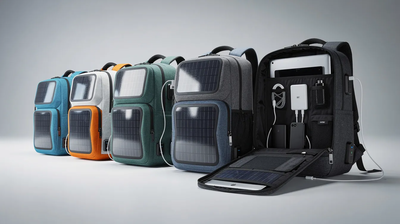
A solar power backpack is a portable bag with integrated photovoltaic panels that convert sunlight into electrical energy to charge devices like phones, tablets, or cameras.
Picture yourself four days into a backcountry trail in 2026. Your GPS is down to 15%, your phone died yesterday, and the next town with electricity is still three days out. A well-chosen solar power backpack could have kept those devices running. But would it have been worth the extra weight and money for your particular trip?
A solar power backpack is exactly what it sounds like: a bag with an integrated solar panel—typically rated between 5 W and 30 W—designed to convert sunlight into electricity you can use for charging phones, GPS units, headlamps, and other small devices. Many include a bundled power bank and USB output ports so you can store energy and charge gear after dark.
How Solar Power Backpacks Work (Without the Jargon)
Core Components
- Solar panel: Typically 7 W on compact hydration packs, scaling up to 14–30 W on larger 30–35 L bags; most quality panels use monocrystalline silicon cells for better efficiency.
- Charge controller: Sometimes integrated into the panel or power bank, this regulates voltage to protect your devices.
- Power bank: Usually 10,000–20,000 mAh capacity, either included or purchased separately; stores energy so you can charge gear when the sun isn’t shining.
- Output ports: Most commonly 5 V USB-A; some newer models include USB-C for faster charging on modern phones and tablets.
How Power Flows
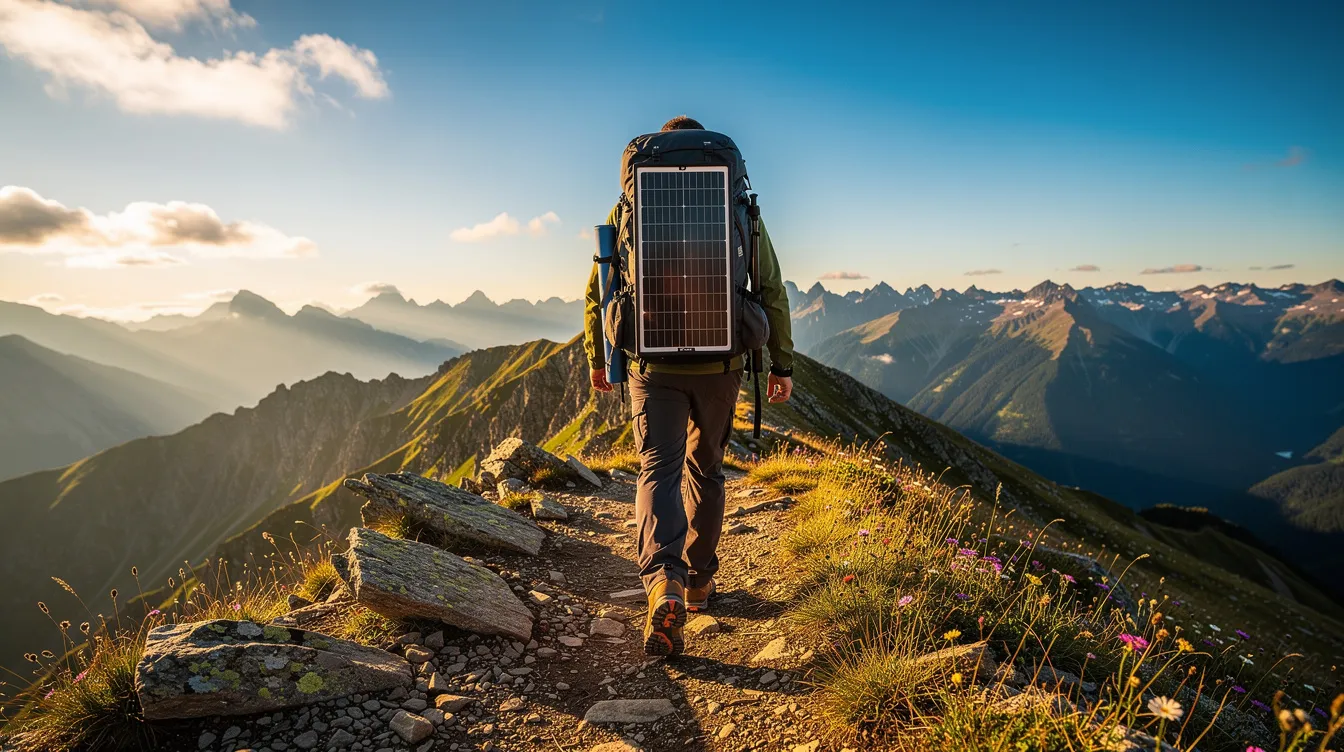
- Sun hits the panel on your backpack.
- The panel generates DC electricity.
- Electricity flows into the power bank inside your pack.
- You charge your phone, GPS, or headlamp from the bank when you stop for breaks or camp.
Why not plug your phone directly into the panel while walking? Because intermittent shade from trees, your body movements, and constantly changing panel angles create unreliable, stop-start charging that can actually harm some batteries and wastes potential energy.
Performance Factors
Real-world numbers to set expectations:
- In strong midday sun (~1,000 W/m²), a 7 W panel may deliver around 4–5 W to a power bank after conversion losses.
- Over 4–5 peak sun hours, this equals approximately 20 Wh—roughly half to three-quarters of a 2024 smartphone battery (most are 10–20 Wh).
- A 14 W panel under the same conditions can approach a full phone charge per good sunny day.
Are Solar Power Backpacks Worth It for Hiking & Backpacking?
Comparing Use-Cases by Trip Length
Trip Type | Recommended Setup |
|---|---|
Weekend trips (1–3 days) with outlet access | 10,000–20,000 mAh power bank only |
Section hikes (4–10 days) in sunny months | Solar backpack or detachable panel + power bank |
Thru-hikes/expeditions (10+ days between towns) | Solar panel/backpack with 20,000+ mAh storage |
Weather Reality Check
- Overcast skies can drop panel output below 30% of rated power.
- Dense forest trails mean limited direct sun for most of your hiking day.
- Best-case scenarios: high alpine terrain, desert hiking, or open ridgelines in summer.
Recommendation Matrix
- Mostly weekend hikes: Stick to power banks—simpler, lighter, cheaper.
- Regular 5–7 day unsupported trips in sunny areas: Consider a 10–14 W solar backpack.
- Ultralight gram-counters: A separate high-efficiency folding panel strapped to your existing lightweight pack often beats integrated solar backpacks.
Real-World Examples: Mountaineering Bags
Let’s walk through the main categories of solar backpacks you’ll find on the market, with realistic specs and price ranges from 2022–2025 Amazon listings.
Mid-Size Commuter and Travel Solar Backpacks (20–35 L)
- Example specs: 14 W nylon solar panel, dual USB ports, 25–30 L capacity, priced around $55–$70
These work well for students and daily commuters who want laptop space plus solar trickle charging. Look for models with built-in power banks advertised at 5 V / 2 A output for phones and tablets. Some premium designs run $140–$150 with more robust panels and waterproof zippers.
Urban/Anti-Theft Laptop Solar Bags
- Example specs: Waterproof materials, anti-theft zips, padded 15–17” laptop sleeve, 7–10 W panel, priced around $100
Marketed more for business travelers and digital nomads than hardcore thru-hikers. These prioritize security features and professional styling over maximum solar output.
Advantages of Separate Solar Panels (10–21 W Folding Panels) Paired with a Standard Hiking Backpack
- More flexibility: angle and hang the panel at camp, or leave it charging with your tent while you scout ahead
- Easier upgrades: when panel technology improves, swap the panel without buying a whole new pack
- Freedom to choose any backpack that fits your torso length, hip belt preference, and frame style
Durability and Repair Considerations
- If the panel on an integrated solar backpack fails, repairing or replacing it can be difficult without manufacturer support.
- Separate panels from established brands often have replacement clips and cables available, and can outlast multiple packs.
Rule-of-Thumb Conclusion
- Gear-focused hikers who already own well-fitting packs: usually better off with a separate solar panel plus power bank.
- Casual users, commuters, and students: an integrated solar backpack is simpler and “good enough” for light charging needs.
Key Buying Considerations (How to Choose the Right Solar Backpack)
Panel Power and Efficiency
- Minimum 7 W for light day use
- 10–14 W for multi-day hiking
- 20–30 W for heavy use (tablets, camera batteries, multiple devices)
- Look for monocrystalline panels—they offer 18–22% efficiency vs. older amorphous designs at 10–13%
Included Power Bank vs. BYO (Bring Your Own)
- Kits bundling a size-matched power bank (e.g., 10,000 mAh with 7–10 W panel) simplify setup
- Check if the power bank is removable
- Ensure at least 2 A output for faster phone charging
Backpack Capacity and Fit
Use Case | Recommended Capacity |
|---|---|
Daily commuting | 15–25 L |
Weekend trips | 25–35 L |
Multi-day trekking | 50–70 L |
- Torso length, hip belt design, and shoulder padding matter as much as the panel for serious hiking.
Durability and Waterproofing
- Look for 600D polyester, 600D Oxford cloth, or quality nylon
- Panels are often water-resistant, but USB ports and power banks may need additional protection
- Consider a backpack rain cover or dry bag for extended bad-weather exposure
Port Layout and Compatibility
- At minimum: one external USB-A port
- Ideal: USB-C for charging newer phones
- Avoid designs that bury ports deep where cables get kinked or crushed
Weight and Use-Case Tradeoffs
- A heavier 30 W pack might be overkill for someone only topping up a phone twice a week.
- Balance “energy independence” against how many hours per day you actually have direct sun while hiking or commuting.
Social Impact: Solar Backpacks Beyond Recreation
Solar backpacks aren’t just adventure gear. In communities without reliable electricity, they’re changing lives.
The Cost Comparison
- A $4–8 school-focused backpack plus solar light can undercut what families spend on kerosene in just a few weeks.
- The long-term savings are significant, and eliminating kerosene fumes reduces indoor air pollution—a real health benefit, especially when paired with safe, efficient headlamps for hiking adventures and other modern lighting.
Day Hiker
What to look for:
- Compact hydration-style solar backpack with 1.5–2 L bladder
- 7 W panel with 10,000 mAh battery
- Target price: ~$80–100
- Minimum 4.5/5 star average rating on Amazon
Focus on light weight, simple organization, and enough power to top up a phone and headlamp through a sunny adventure.
Weekend Backpacker & Light Traveler
What to look for:
- ~30–40 L solar backpack with 10–14 W panel
- Robust hip belt for carrying 10–12 kg of gear
- Good balance between capacity and panel size for 2–4 day trips
Pair with a 10,000–20,000 mAh bank to buffer cloudy days. This setup provides real peace of mind without expedition-level weight.
Care, Use & Safety Tips for Solar Power Backpacks
Maximize your solar backpack’s lifespan and performance with these practical habits.
Positioning for Best Charging
- On trail: adjust straps so the panel faces roughly up and back toward the sun.
- At camp: unclip or prop the pack so the panel faces midday sun at a 30–45° angle.
- Even small angle adjustments can significantly boost charging speed.
Charging Strategy
- Always charge the power bank first, then charge devices from the bank.
- This avoids intermittent power cycles that can harm some device batteries.
- Top up during every bit of sun, not just when the bank reads “low”—clouds can appear without warning.
Weather and Water Protection
- Most panels are water-resistant, but prolonged heavy rain can damage ports and electronics.
- Use a rain cover or backpacking rain poncho for the backpack.
- Keep the power bank and cables in a small dry bag or zip pouch.
Cable and Port Care
- Use short, high-quality USB cables.
- Avoid tight bends at the panel’s junction box.
- Never yank cables out of ports—consider right-angle connectors if port orientation causes strain.
Storage and Cleaning
- Store the pack in a cool, dry place away from prolonged high heat (don’t leave it baking on a car dashboard).
- Clean the panel surface periodically with a soft damp cloth to remove dust and sunscreen that reduce efficiency, just as you would with the exterior of a solar shower system.
Safety Notes
- Low-voltage DC output (5–18 V) is generally safe, but replace damaged cables or exposed wires promptly, just as you would with any LED camping lantern.
- Lithium power banks are sensitive to crush and puncture—keep them in padded internal pockets, similar to how you’d protect a rechargeable camping lantern.
- If a battery pack swells or shows damage, stop using it immediately, whether it’s connected to a backpack panel, solar lantern light, or any other device.
FAQ: Solar Power Backpacks
Can a solar backpack fully replace wall charging for my phone on a week-long hike?
In ideal summer sun with a 10–14 W panel, you may keep a single phone topped up for a week—if you’re conservative with usage (airplane mode, offline maps, limited screen time). In mixed weather or forested terrain, assume only partial replenishment and start with a full power bank from home. Never rely on solar alone for critical navigation or emergency communication; always have a backup plan.
Is it safe to fly with a solar power backpack and its battery?
The backpack and panel are fine in either checked or carry-on luggage since they’re passive components. However, lithium power banks must typically go in carry-on baggage under FAA/IATA rules, and banks over approximately 100 Wh may require airline approval. Check the Wh rating on your power bank (a 10,000 mAh bank at 3.7 V equals about 37 Wh) and verify airline requirements before international trips—some carriers have tightened restrictions in 2025–2026.
Will a solar power backpack charge my laptop?
Most consumer solar backpacks output 5 V via USB, which works for phones, small cameras, and some tablets—but not enough for most laptops. A few higher-end systems combine 20–30 W panels with power banks offering USB-C Power Delivery (30–60 W), which can trickle-charge ultrabooks and MacBooks. If you need reliable laptop charging, look for dedicated solar generator setups rather than relying solely on a small backpack panel.
How long do the solar panels on backpacks typically last?
Quality monocrystalline panels often retain 80%+ of their rated output after 3–5 years of regular outdoor use if not physically damaged. The bigger risks are cracked cells from impacts, broken wiring at stress points, and worn-out ports—not the panel “wearing out” from sunlight. Choose products with at least a 1–2 year warranty on the solar module and treat the panel as electronics, not indestructible gear.
Can I remove or upgrade the panel on a solar power backpack?
Some designs use detachable panels secured with clips or MOLLE-style webbing, allowing you to upgrade or move the panel to a different pack. Many cheaper models sew the panel directly into the fabric, making replacement difficult without DIY modification. Gear tinkerers who want future-proofing might prefer a backpack with a detachable panel—or simply pair a standard pack with a separate folding panel to avoid being locked into one configuration.


Member discussion