

Navigating through wilderness, across oceans, or within bustling cityscapes demands a dependable tool for direction. For centuries, the sighting compass has been an indispensable companion for explorers and adventurers alike. This comprehensive guide delves into sighting compasses, exploring their various types and how they ensure precise navigation.
Key Highlights:
- Discover the different types of sighting compasses and their unique applications.
- Learn how to use a sighting compass for accurate and reliable navigation.
- Explore technological advancements that enhance traditional compass designs.
Understanding a Sighting Compass
A sighting compass is a specialized instrument equipped with a sighting mechanism to obtain exact bearings on distant objects. Unlike standard compasses, it employs a direct sighting system to align with landmarks or celestial bodies, delivering highly precise readings.
Types of Compasses and Their Features
Compasses come in a variety of forms, each designed for specific scenarios. The mirror compass, lightweight and compact, is perfect for backpackers, allowing simultaneous viewing of the compass dial and the surrounding terrain. The baseplate compass, commonly used in orienteering, features magnetic zones on a transparent base for effortless map reading. The prismatic compass, with its integrated glass prism, enables direct reading for enhanced accuracy. Marine compasses are built to endure the demanding conditions of sea navigation.
The Impact of Magnetic Fields on Navigation
Sighting compasses rely on Earth’s magnetic field for orientation. Different magnetic zones influence navigation, making it essential to select a compass suited for your geographic region. The magnetized needle aligns with Earth’s magnetic lines, pointing to magnetic north, helping navigators determine true north and their precise position.
Advanced Sighting Techniques
Advanced navigation methods incorporate features such as magnifying lenses, luminous markings, and adjustable declination to compensate for the difference between magnetic north and true north.
Optical Sight and Lensatic Compasses
Lensatic compasses, often referred to as military compasses, utilize an optical sight for superior precision. Looking through the lens allows you to adjust the azimuth on the index line while aligning sights with a target. Equipped with a liquid-damped capsule and jeweled bearings, these compasses offer stability and durability. The optical sight lets you focus on distant objects while simultaneously reading the compass, ensuring accurate direction.

Modern Compasses and Technological Integration
Contemporary compasses integrate electronic components to boost precision. GPS compasses use satellite signals for positioning, while solid-state compasses in smartphones and vehicles rely on magnetic field sensors. Traditional magnetic compasses, prized for their simplicity and reliability, continue to depend on Earth’s magnetic field.
Non-Magnetic Compasses and Their Uses
Non-magnetic compasses, such as gyrocompasses and solar compasses, operate independently of Earth’s magnetic field. They are especially valuable in polar regions or areas with heavy ferrous metal interference.
The Evolution of the Compass
The compass has evolved to meet explorers’ changing needs. The liquid compass, featuring a magnetic needle suspended in fluid, reduces oscillations for stable readings—ideal for maritime navigation. Solid-state compasses, which use electronic sensors, are durable and commonly integrated into devices like smartphones and GPS units.
The Thumb Compass in Orienteering
Orienteering demands quick, accurate navigation using a map and compass. The thumb compass, worn on the thumb, allows rapid reference. Its clear needle makes it easy to read while holding a map, streamlining navigation for swift decision-making.

Practical Navigation with a Sighting Compass
Using a sighting compass involves aligning its components precisely with your surroundings. Mirror compasses enable simultaneous viewing of the dial and reference point, facilitating accurate bearings. Features like damping mechanisms and tripod mounts enhance stability.
Achieving Accuracy in the Field
Accuracy hinges on familiarity with compass features such as magnifying lenses for detailed map reading and luminous markings for low-light conditions. Aligning the dial with the map and centering the needle within the orienting arrow ensures precise navigation. Adjustable declination is especially useful when traveling across different magnetic zones.
Specialty Compasses for Various Purposes
Thumb compasses, designed for fast-paced sports, attach to the thumb for quick reference. Mirror compasses, ideal for long-distance navigation, allow accurate bearings by viewing both the dial and background simultaneously. Marine compasses withstand harsh environments, often using lamp oil to dampen needle movement. Magnetic compasses serve as multiple precision instruments for specialized needs.
Compasses for Astronomical Navigation
For star navigation, compasses equipped for direct sighting of celestial bodies are essential. Features like luminous markings support reliable nighttime navigation.
The Significance of a Reliable Compass
A dependable compass is vital for outdoor adventures. Whether hiking or sailing, a compass with rugged construction and a liquid-damped capsule helps ensure you reach your destination safely.
Selecting the Right Compass
Choose a compass based on your needs, whether for hiking, surveying, or boating. Each type offers specific features suited to different scenarios. Consider additional precision features if higher accuracy is required.
Compass Maintenance and Care
Regular maintenance preserves accuracy. Avoid strong magnetic fields, keep the housing clean, and check for air bubbles in liquid compasses, which indicate leaks.
Resolving Common Compass Issues
Erratic readings may result from nearby metal or magnetic interference. Test your compass in a non-magnetic environment. Persistent problems may require professional calibration or replacement.
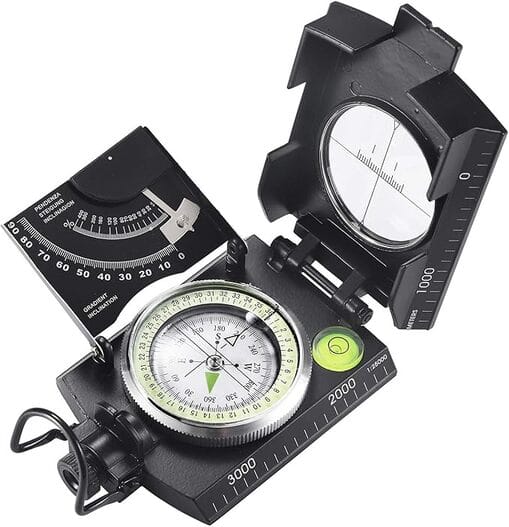
Best Sighting Compass
Eyeskey Multifunctional Military Sighting Navigation Compass
Summary
The sighting compass is an essential tool for precise navigation, offering accuracy through various features and types. Understanding how to use and maintain your compass ensures dependable guidance. Whether you’re an experienced explorer or a casual hiker, a quality compass is your trusted companion in outdoor adventures.
FAQ Section
Q: How can I verify my compass’s accuracy?
A: Test it away from magnetic fields and metal objects. Compare readings with a known bearing or GPS. Consistent results indicate accuracy.
Q: Can I use my compass worldwide?
A: Most compasses function globally, but near magnetic poles, a global needle compass is recommended. Adjustable declination helps when navigating different magnetic zones.
Q: What distinguishes magnetic north from true north?
A: Magnetic north is the direction the compass needle points, aligning with Earth’s magnetic field. True north points toward the geographic North Pole. The difference, called magnetic declination, varies by location.


Member discussion