
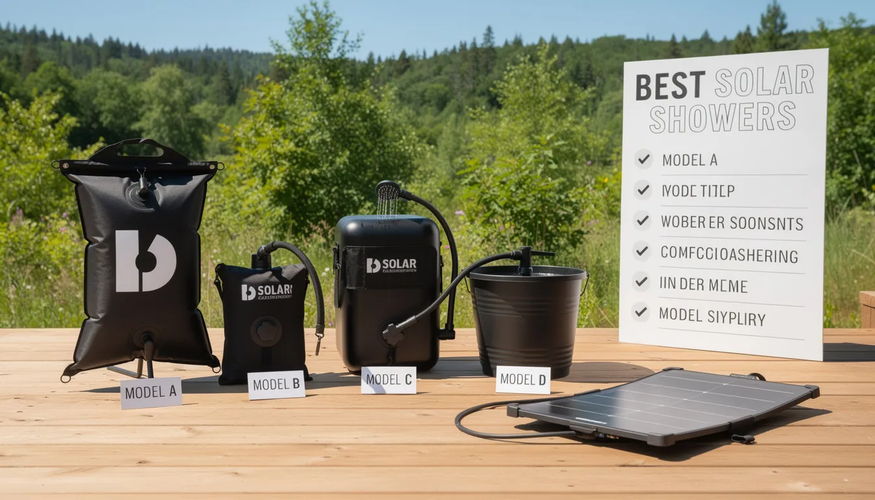
Key Takeaways
- A solar shower is a portable container that uses the sun to heat water for off-grid washing. In 2025, better materials and smarter designs make them more reliable than older PVC models for car camping, vanlife, festivals, and emergency kits.
- The Advanced Elements Summer Shower (4–5 gal) stands out as the best overall solar shower bag for its balance of fast heating, accurate thermometer, and long-term durability at around US$35–40. If you want pump-pressurized flow instead of gravity, the NEMO Helio Pressure Shower is the top pick.
The three most important buying decisions are capacity (3–10 gal based on group size), expected heating time (2–6 hours in full sun), and how you plan to hang or mount the shower at camp.
- A dedicated shower tent like the NEMO Heliopolis or Kelty Privacy Tent is optional but makes using any portable camping shower far more comfortable and private.
Best Solar Showers of 2025: Quick Recommendations
If you want the fast answer without scrolling through detailed reviews, here are the top picks across different categories and budgets. Each model either heats water directly through solar absorption or works especially well with sun-warmed water.
- Best overall solar shower bag: Advanced Elements Summer Shower 5 gal — fast heating with a dark back and clear front, an accurate built-in thermometer, reinforced handle that lasts for years. Around US$35–40.
- Best budget solar shower: Coghlan’s Solar Camp Shower 5 gal — under US$25, basic black PVC design that gets the job done if you treat it gently and don’t expect multi-season durability.
- Best pressurized solar-friendly shower: NEMO Helio Portable Pressure Shower 11 L — the black tank warms in the sun, foot pump delivers real water pressure, sits on the ground so you never lift heavy bags overhead. About US$150.
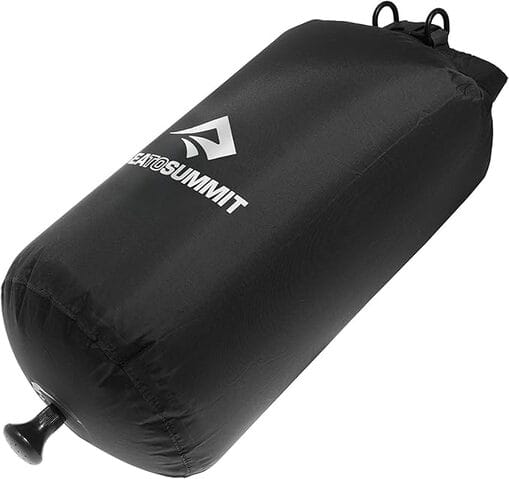
- Best ultralight solar shower: Sea to Summit Pocket Shower 10 L — around US$40, doubles as a dry sack, light enough for backpacking when every ounce counts.
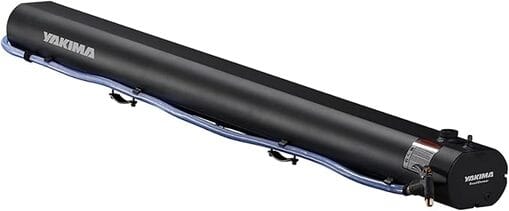
- Best roof-mounted solar shower: Yakima RoadShower 7 gal — heats fast on your car roof while driving or parked, delivers garden-hose-like pressure, built tough. Around US$449.
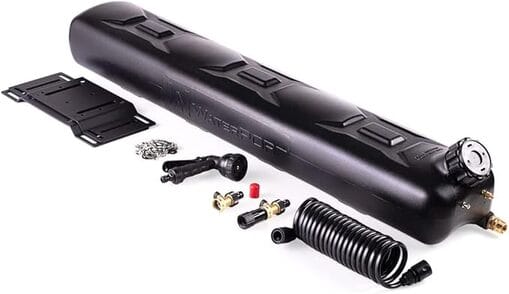
- Best potable roof-mounted alternative: Klymit WaterPORT 8 gal — BPA-free polyethylene keeps water safe for drinking and brushing teeth, strong flow, about US$380–400.
- Best NZ/Australia-available basic solar bag: Coleman PVC Solar Shower 18.9 L — common in Australia and New Zealand outdoor shops, warms in about 2–3 hours on sunny days, budget-friendly.
Advanced Elements Summer Shower (Best Overall Solar Shower Bag)
The Advanced Elements Summer Shower has earned its reputation as the best all-round solar camping shower through years of real-world testing in campgrounds across North America. When you need reliably warm water without fussing over complicated setups, this is the shower bag most experienced campers reach for.
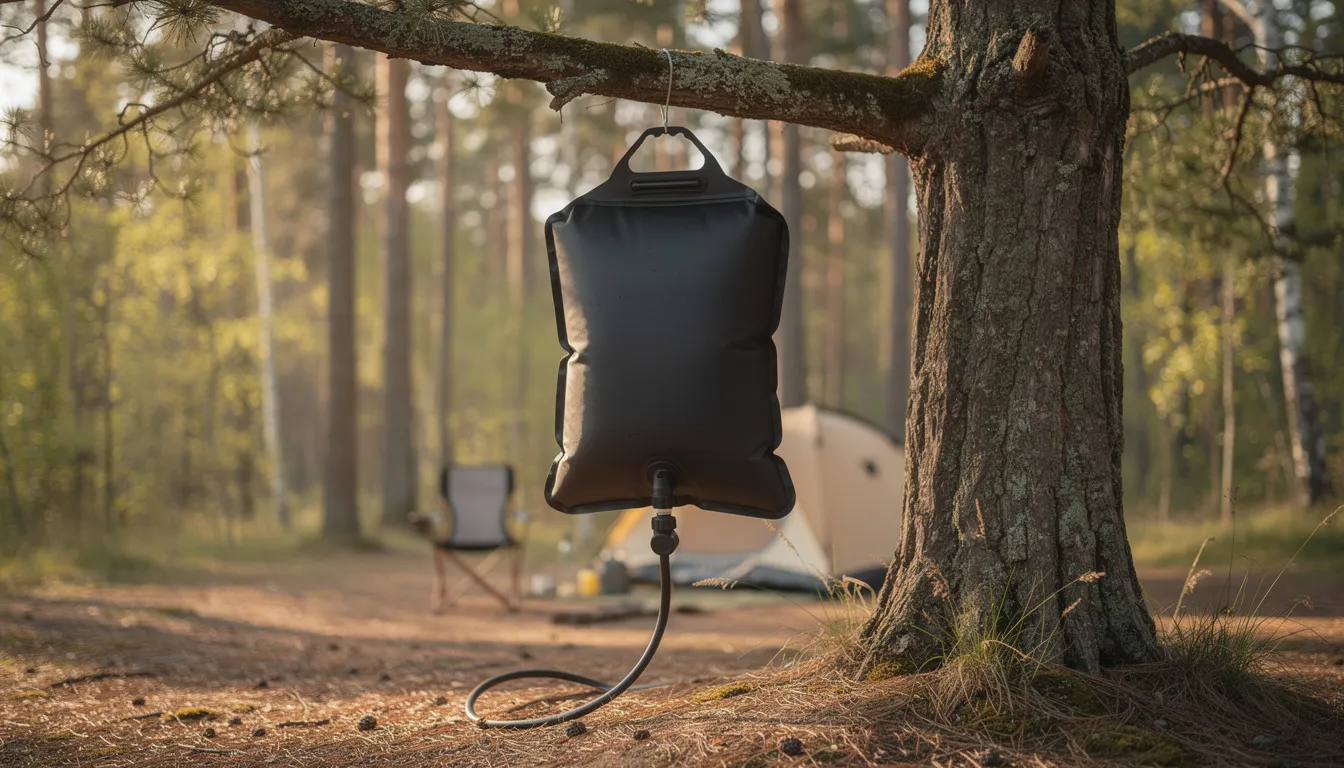
Key specifications:
- Common sizes: 2.5 gal, 4 gal, 5 gal, and a bulky 10 gal version
- 2025 price range: US$30–45 depending on capacity
- Typical heating: reaches 100–110°F (38–43°C) in approximately 3–4 hours of full summer sun when ambient air is around 80°F (27°C)
- Shower time: about 4–6 minutes of continuous flow from the 4–5 gal versions at moderate flow settings
The sweet spot for most campers is the 4 or 5 gallon size. Large enough for a proper rinse without becoming unmanageable when full.
Design and usability features:
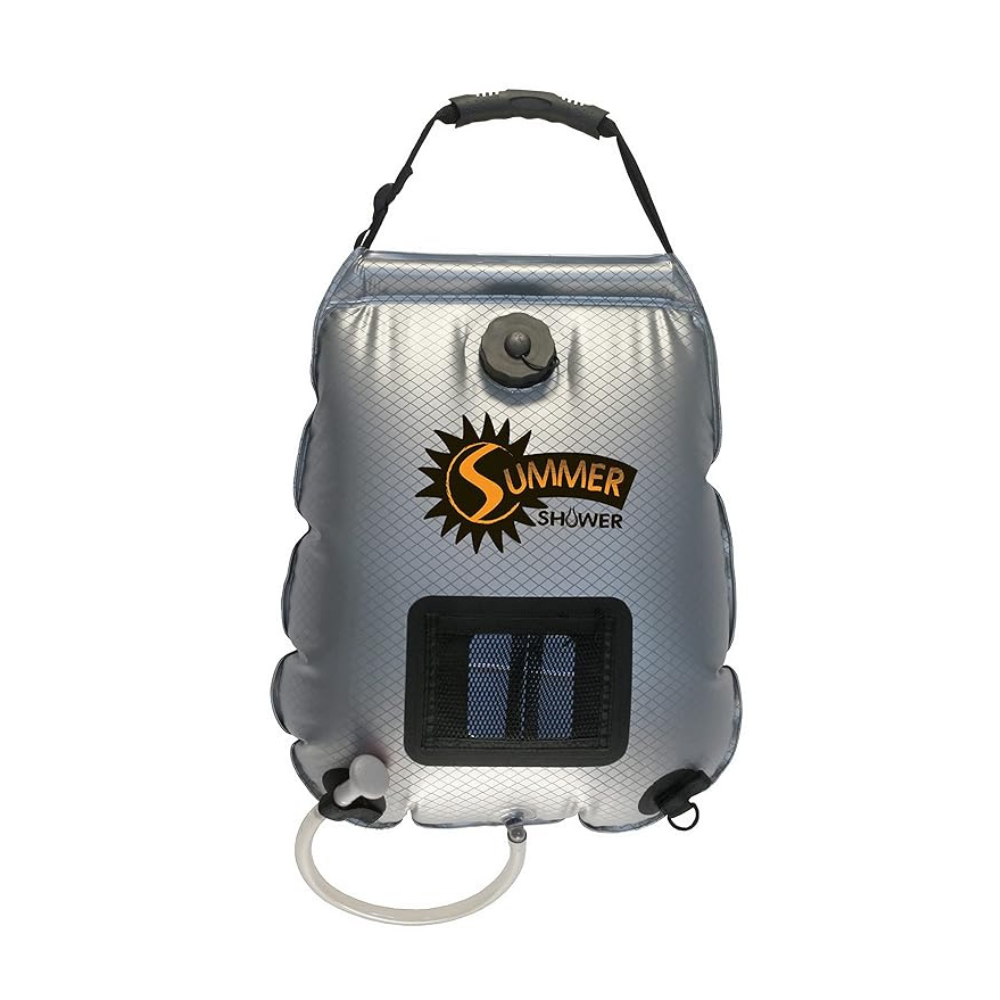
The Summer Shower uses a dark back panel combined with a translucent front for faster solar gain. This lets sunlight penetrate while the dark surface absorbs and retains heat. A built-in temperature gauge printed directly on the bag eliminates guesswork about whether your hot water is actually hot. The wide, reinforced buckle handle clips easily to tree branches, cargo racks, or shower tent hooks without the handle failures that plague cheaper bags.
Small extras matter here: an external pocket with a small mirror keeps toiletries organized, and the twist-style shower head can be locked off completely to prevent drips between uses.
Performance strengths:
The gravity shower pressure is surprisingly solid for washing hair and rinsing soap. With careful water management using the wet–lather–rinse technique, a 5-gallon bag provides enough warm water for 1–2 people. Users report minimal dripping or hose leaks even after repeated use across multiple camping seasons.
Drawbacks to consider:
The 5 gallon version weighs approximately 40 lb (18 kg) when full, which many people find difficult to hoist overhead. Getting this weight up to a suitable hanging height takes some planning. After use, the interior takes a surprisingly long time to dry fully—expect 1–2 days hanging upside down with the cap off before storage. The fill port, while convenient for garden hoses and spigots, becomes awkward when you need to scoop fresh water from rivers or streams.
Verdict: The Advanced Elements Summer Shower is the right camping shower for most car campers and overlanders who can manage lifting it. It serves as an excellent benchmark against which to compare cheaper solar camping showers.
NEMO Helio Portable Pressure Shower (Best Pressurized Solar-Friendly Shower)
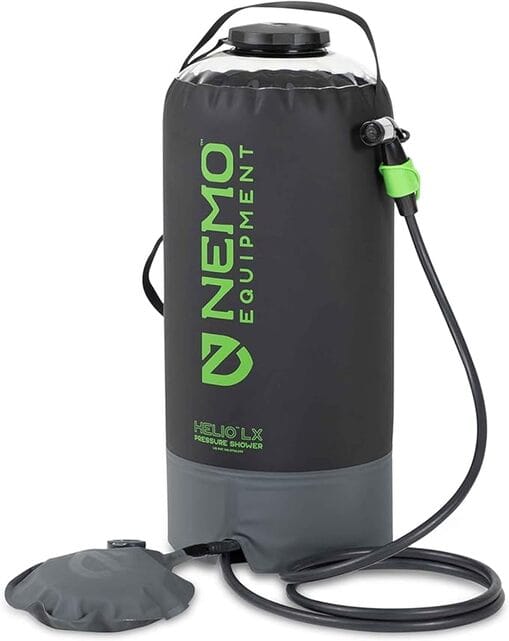
The NEMO Helio isn’t a classic hanging gravity shower—it’s a dark, ground-standing tank that warms passively in the sun and then delivers pressurized water through a foot pump system. This makes it the best portable shower for campers who want actual shower pressure without the arm workout of hoisting heavy bags.
Model details:
- Standard Helio: 11 L (about 2.9 gal), typical run time 7–8 minutes with intermittent pumping
- Helio LX: 22 L (about 5.8 gal) for families or group camps
- 2025 improvements: sturdier carry handles, larger vertical fill lid, stiffer base that resists kinking, better gasket for holding pressure
- Street price: approximately US$150 for the standard Helio, more for the LX
Key advantages:
The foot pump keeps your hands free and boosts water pressure well beyond what any gravity bag can deliver. This makes a real difference when washing hair, rinsing muddy dogs, or cleaning off bike gear. Since the tank sits on the ground, you never need to lift 40+ lb bags overhead—a significant advantage for solo campers or anyone with shoulder issues.
The wide opening on the LX version accepts pre-heated water from a kettle or camp stove for early-morning showers when solar heating isn’t available. The whole system packs into a compact protective stuff sack, making storage in a car or van straightforward.
Limitations:
The dark fabric warms water but won’t reach temperatures as high as a dedicated clear-front solar bag like the Advanced Elements. In shoulder seasons, you’ll likely need to add some boiling water to reach a comfortable warm shower temperature. There’s no built-in temperature gauge, so you test the water by hand before committing. The 22 L version becomes heavy when full, so fill it near where you plan to use it rather than carrying it across camp.
Ideal use cases: The Helio Pressure Shower works best for campers who prioritize consistent pressure over maximum heat, people who struggle to lift heavy bags, and vanlifers who occasionally supplement with stove-heated water.
Sea to Summit Pocket Shower (Best Ultralight Solar Shower)
When pack weight matters more than a home shower experience, the Sea to Summit Pocket Shower delivers a functional solar shower at a fraction of the weight of car-camping bags. Available in 3 L and 10 L variants, the 10 L ultralight model is the practical choice for backpackers in 2025.
Specifications:
- Weight: approximately 4–6 oz (120–170 g) depending on size
- Capacity: 10 L provides roughly 7–8 minutes of gentle flow at low pressure
- Price: generally US$35–45
- Material: lightweight, PU-coated fabric with roll-top closure and removable shower rose
Heating and performance:
The Summit Pocket Shower heats more slowly and to slightly lower temperatures than heavier car-camping bags because there’s no clear solar window for direct sunlight penetration. In moderate summer conditions, water temperature typically ends up 15–20°F (8–11°C) above ambient after a few hours of direct sun exposure. The flow is intentionally weak to conserve water, making this backpacking shower best suited for rinsing off sweat and dust rather than deep-cleaning muddy gear.
As one long-term Trailspace reviewer noted after about four years of use: if you want a truly hot shower from this bag, you may need to heat water on your camp stove and add it to what’s already warm.
Design tradeoffs:
The roll-top opening makes it easy to scoop water from lakes or streams, and the same bag doubles as a dry sack when empty. Sealing the roll-top fully leakproof takes practice—it can drip if not rolled tightly. The included hanging cord and guyline handle work well, though the handle may feel slightly bulky for some shower tent hooks.
Verdict: The Sea to Summit Pocket Shower is best for thru-hikers and minimalist backpackers who prize weight savings over full-comfort showers. It’s a step up from wet wipes without adding significant pack weight—consider adding quick-dry towels to further improve your camp hygiene experience.
Yakima RoadShower & Klymit WaterPORT (Best Roof‑Mounted Solar Showers)
Roof-mounted solar showers represent the premium end of off-grid washing. These are rigid tanks that live permanently on your vehicle’s roof rack, heat all day while driving or parked, and deliver garden-hose-like pressure on demand. If you’re building out a van or spending weeks overlanding, these systems pay for themselves in convenience.

Yakima RoadShower 10 gal
- Capacities: 4, 7, and 10 gallon models available; the 7 gallon version is most popular at around US$698 in 2025
- Material: powder-coated aluminum, strong and UV-resistant
- Heating: black tank reaches shower temperatures in 1.5–3 hours of strong sun; external temperature strip helps you monitor without opening
- Pressure: Schrader valve accepts air pump or compressor input, delivering strong spray that tapers as the tank empties
- Downsides: heavy installation, requires compatible roof rack, time-consuming initial setup; overkill for weekend camping trips
One important note: the aluminum construction means water in a RoadShower is not potable. Use it only for washing, not drinking.
Klymit WaterPORT 8 gal
- Capacity: 8 gal (~30 L) with coiled hose and multi-setting nozzle
- Material: BPA-free polyethylene, keeping water safe for drinking, rinsing dishes, or brushing teeth
- 2025 price: approximately US$380–400
- Heating: similar solar heating curve to Yakima; large surface area plus black exterior achieves hot water by mid-afternoon
- Mounting: fits roof racks or hitch mounts but requires brackets and some DIY fitting work
Quick comparison
Feature | Yakima RoadShower | Klymit WaterPORT |
|---|---|---|
Material | Aluminum | BPA-free polyethylene |
Potable water | No | Yes |
Typical capacity | 4–10 gal | 8 gal |
2025 price | ~US$449 (7 gal) | ~US$380–400 |
Best for | Long-term overlanding | Families wanting one multi-use tank |
Maintenance notes: Drain these tanks completely before freezing temperatures arrive. Check fittings periodically for slow leaks. Don’t leave them pressurized indefinitely—release pressure after each use to extend gasket life.
Other Notable Solar & Solar-Compatible Camping Showers
While gravity bags and roof tanks are true solar showers, many popular camp shower systems pair well with solar-heated water. Here’s a quick look at alternatives worth considering.
DIY and budget alternatives:
- Black-painted garden sprayers or jerry cans left in the sun can mimic a pressurized shower for far less money
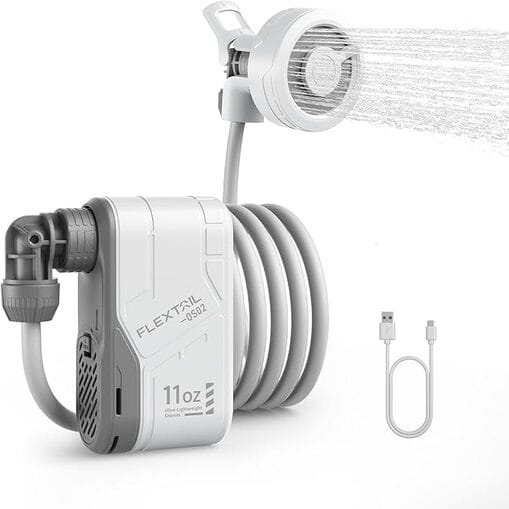
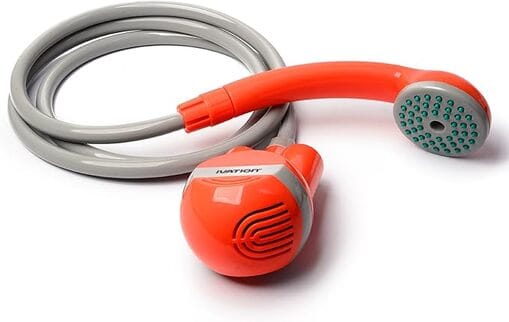
- Battery pump kits (like Ivation or Flextail Max Shower) pair with any dark bucket or collapsible bucket warmed in the sun, creating cheap semi-solar setups
- A simple water bottle with holes poked in the cap works in a pinch for a quick rinse
These hacks won’t match the convenience of purpose-built gear, but they demonstrate that solar heating is fundamentally just about dark containers and sunlight.
How to Choose the Best Solar Shower for Your Trip
The right camping shower depends entirely on your group size, trip style, how long you stay off grid, and whether you can physically lift heavy water bags overhead. There’s no universal “best” option.
Capacity and group size: A 3–4 gallon (11–15 L) shower bag works well for solo campers or couples. Families or groups need 5–8 gallons (19–30 L) to avoid constant refilling. Remember that each extra gallon adds about 8 lb (3.6 kg) of weight when full.
Heating time and climate: In full summer sun at moderate elevations, most dark solar bags reach 100–105°F (38–41°C) in 3–4 hours. During shoulder seasons or cloudy weather, water may barely get degrees warmer than ambient—often just lukewarm. Factor your typical camping conditions into your expectations.
Pressure type: Gravity showers are simple and reliable but deliver low-pressure flow. Foot-pump systems like the NEMO Helio or Quechua offer decent pressure for washing hair. Roof tanks provide true pressurized shower experiences. If you’re washing long hair, rinsing pets, or hosing down bikes, prioritize pressurized options.
Portability and storage: Ultralight sacks like the Sea to Summit pack to pocket size but have weak flow. Roof tanks and propane heaters are heavy and semi-permanent but incredibly convenient for vehicle-based camping. Match your shower choice to how you travel.
Budget guidelines for 2025: | Category | Price Range | What You Get | Basic solar bags | US$20–50 | Simple heating, basic valves, 1–2 season durability | | Quality pressurized portables | US$80–160 | Better materials, foot or hand pump, multi-year use | | Roof-mounted systems | US$350–500+ | Premium durability, excellent pressure, permanent installation |
Matching shower to campsite:
- If you always camp near trees, a gravity bag plus some rope is perfectly adequate
- In deserts or alpine regions with few hanging options, opt for Helio-style pump systems or roof-mounted tanks
- For festivals and vanlife, privacy tents may matter as much as the outdoor shower itself—factor that cost into your budget. If you're looking for hydration solutions for camping or outdoors, explore the best options available.
Using and Setting Up a Solar Shower Effectively
Getting reliably warm water and decent pressure from any solar shower comes down to a few simple practices. Even cheaper models perform better when you set them up correctly.
Filling: Use campground taps or water jugs whenever possible for clean, consistent water quality. If filling from lakes or streams, basic filtration or even just letting sediment settle for a few hours helps avoid clogging small shower heads. River water works fine for washing but may need straining.
Placement for heating: Lay your shower bag flat with the dark side facing up on a reflective or insulated surface—a light-colored car hood, a foam sleeping pad, or even a space blanket underneath. Rotate the bag occasionally so all the water heats evenly. Avoid deep shade, even partial shadow from trees can add hours to heating time.
Timing: Fill your bag in the morning and plan to shower mid-afternoon when both air and water temperature peak. Waiting until evening means colder ambient temps will start pulling heat from your water before you use it.
Hoisting and hanging: Safely lifting 30–40 lb bags overhead takes planning. Consider using a simple pulley system, spare climbing slings over sturdy branches, or tying bags to vehicle racks at a convenient height rather than wrestling them up solo. A shower tent with reinforced hooks makes hanging easier and provides privacy.
Boosting water temperature
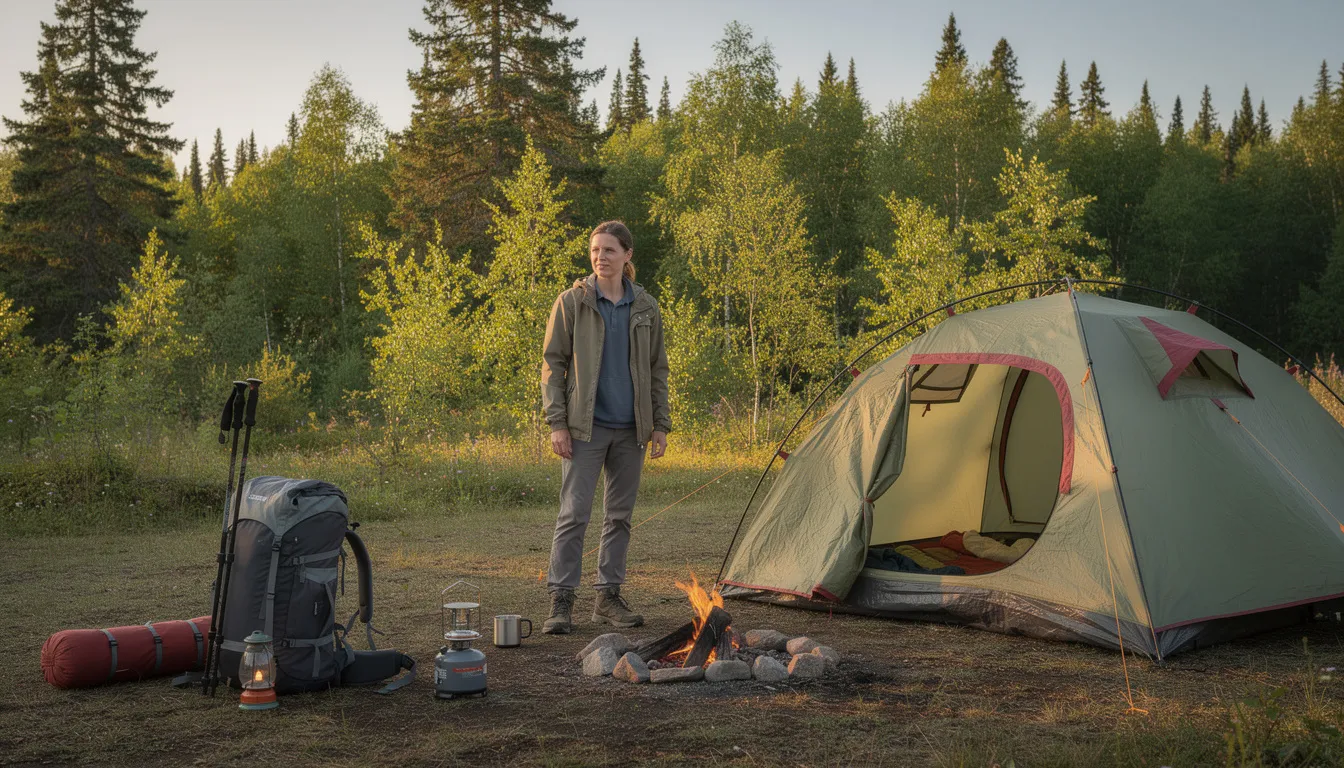
When solar heating alone isn’t enough—common at high altitude or in shoulder seasons—add up to 0.5–1 L of boiling water from your camp stove just before use. This quickly tops up warmth without requiring a full re-heat cycle. Don’t exceed manufacturer temperature limits or mix fully boiling water directly into cold water, which can damage seams or cause scalding.
Conserving water during the shower
The “navy shower” technique stretches limited water capacity: quick initial rinse, shut off flow, soap up completely, then one final rinse. Keep biodegradable soap and a small caddy or mesh bag within easy reach so you’re not fumbling around with wet hands wasting shower water. With practice, a 5-gallon bag can provide one shower for you and still leave enough for a second person.
Care, Maintenance, and Safety for Solar Showers
Proper care extends the life of your solar shower and prevents unpleasant surprises like mold, leaks, or burst seams. A few minutes of maintenance after each camping trip saves money and frustration later.
Cleaning: After trips, rinse your bag with a mild bleach solution (about 1 tablespoon per gallon) or white vinegar, then flush the hose thoroughly. Hang the bag upside down with the cap off for at least 24–48 hours until completely dry inside. Storing a damp bag leads to mold and unpleasant odors that are difficult to eliminate.
Storage: Keep your solar shower in a cool, dry place away from direct sunlight between trips. Prolonged UV exposure degrades plastics and weakens seams over time. Avoid folding along the same crease repeatedly—vary your fold pattern to prevent weak spots from developing.
Inspection and repairs: Before each trip, check seams, hose connections, and valves for slow drips. Many bags can be patched with vinyl repair kits or Tenacious Tape if you catch small holes early. Test your shower at home before heading out if it’s been stored for quite a while.
Freezing conditions: Water expanding during freezes can split seams and destroy valves. If you’re camping at high altitude where overnight temps drop below freezing, drain your shower completely before bed. For winter storage, ensure no water remains in hoses or valve mechanisms.
Safety considerations
- Always test water temperature on your wrist or elbow before committing to a full shower. Some solar bags can exceed 110°F (43°C) on very hot days, hot enough to cause burns.
- Never enclose propane or gas heaters inside small shower tents without proper ventilation. Carbon monoxide buildup is a serious risk even outdoors.
- Secure roof tanks and hanging bags properly. Falls can cause injury or gear damage if a branch breaks, a rope slips, or a rack bolt loosens.
Eco & Leave No Trace Considerations
Solar showers are inherently eco-friendly—they use free sun energy rather than propane or electricity. However, wastewater and soaps can still harm waterways and ecosystems if you’re not careful.
Distance from water: Always shower at least 200 ft (about 60 m) from rivers, lakes, and springs, even when using biodegradable soaps. Soap residue, even “natural” varieties, can harm aquatic life and affect water quality for other campers downstream.
Soap choice: Use unscented, biodegradable soaps sparingly. “Biodegradable” means the soap breaks down over time—it doesn’t mean it’s safe directly in waterways. Soil bacteria and sunlight need time to process these products, so dispersal on dry land is essential.
Runoff management: Direct gray water runoff into sandy or well-drained soil away from water sources. Some sensitive areas require using a shallow cathole or a collapsible basin to collect and properly disperse wastewater. Check local regulations before your camping trip.
Hair and food waste: If you use your portable solar shower for dishwashing, strain hair and food particles from gray water before dispersing it. Small food scraps attract wildlife and can contaminate soil.
Check local regulations for camp showers and gray-water disposal before visiting sensitive alpine meadows, desert springs, or protected backcountry campsites. Leave No Trace principles apply to washing just as much as to campfires and waste.

FAQ
Q1: How long does it actually take a solar shower to heat up?
In strong summer sun with ambient temperatures around 80°F (27°C) and higher, most 4–5 gallon dark solar bags reach a comfortable 98–105°F (37–41°C) in 3–4 hours. Smaller 2.5 gallon bags heat faster, while 7–10 gallon roof tanks may need 4–6 hours for full heating. Clouds, wind, shade, and lower ambient temperatures can add several hours or prevent the water from reaching truly hot temperatures at all. On marginal days, plan to supplement with a water pump drawing from stove-heated water.
Q2: Can I drink the water from a solar shower bag or roof tank?
Some systems like the Klymit WaterPORT use BPA-free polyethylene specifically designed to keep water potable if you start with safe water. However, many other showers—especially aluminum RoadShowers and older PVC bags—are intended only for washing, not drinking. Always check manufacturer guidance. When in doubt, keep separate containers for drinking water and never assume shower water is safe to consume.
Q3: How many people can shower from one 5-gallon solar bag?
A typical 5-gallon (19 L) bag provides one person a long, relaxed shower or 2–3 people quick “navy style” rinses. The key is shutting off flow while soaping up rather than running water continuously. Hair length and shower head flow settings have significant impacts—someone washing hair uses noticeably more water than a quick body rinse. With discipline, a family of four can each get a functional rinse from a single fill.
Q4: Will a solar shower work in winter or at high altitude?
Solar showers still function as water containers in cold conditions, but solar heating becomes much less effective. Low-angle winter sun, cold air temperatures, and wind all reduce heat absorption. At a backcountry campsite in shoulder seasons, your water may stay lukewarm at best. The practical solution is pre-heating part of the water on a camp stove, mixing it with cooler water, and using the solar bag mainly as a convenient container and delivery system rather than relying on the sun alone.
Q5: What’s the difference between a solar shower and a battery-powered camp shower?
A solar shower specifically uses sunlight to heat water in its own dark container—the heating and containment are integrated. Battery-powered showers like the Flextail Max Shower or other electric pump systems only provide water pumping; they rely on you to heat the water separately using sun, stove, or tap. Many experienced campers combine both approaches: warming water in a black bucket or collapsible bucket during the day, then using a battery pump for pressurized delivery. Two D cell batteries power some basic models, while others use rechargeable lithium batteries for extended use. The kitchen sink sprayer-style flow from these pumps can feel more like an actual shower than a gravity bag’s gentle trickle.
Member discussion