
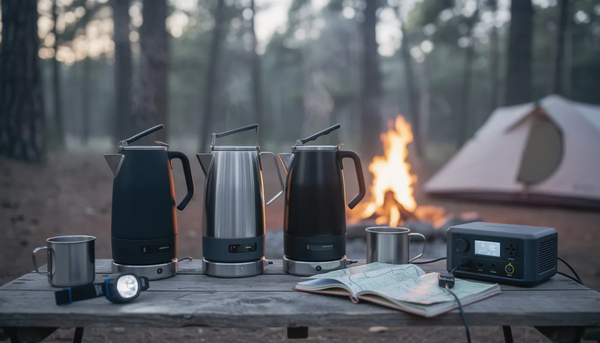
Key Takeaways
- Electric camping kettles usually run between 600 and 1000 watts, which is much lower than the 2000–3000 watts typical of standard home kettles. This makes them safe to use with campsite hookups and portable power stations without the risk of tripping breakers.
- A 750W camping kettle can boil 1 litre of water in around 8–10 minutes while drawing only 3.3 amps—perfect for European campsite connections rated between 6A and 10A.
- Collapsible silicone models compress down to a fraction of their size, making them ideal for motorcycle touring and space-conscious backpackers. Meanwhile, 12V car kettles are best suited for slow “boil on the move” scenarios.
- Genuine Wild thoroughly tests and recommends specific models available on Amazon, focusing on durability, actual boil times, and compatibility with popular power stations like Jackery and EcoFlow.
- For wild camping without electricity, gas stoves remain the practical choice. However, at powered sites, caravans, and vans, electric kettles offer convenience, safety features, and a hot cup of tea in minutes.
How to Power an Electric Camping Kettle Outdoors
There are three main ways to power electric camping kettles in the field: campsite hookups (EHU), campervan or caravan electrics, and portable power stations. Each has distinct advantages depending on your camping style.
Campsite Electric Hook-Up (EHU)
- Standard UK/EU 230V supply, typically rated between 6A and 16A.
- A 6A supply delivers up to 1380W; 10A supplies 2300W; 16A supplies 3680W.
- Match your kettle wattage to the supply—a 750W kettle is generally safe on 6A, while 1000W models suit 10A+ connections.
- Running multiple appliances simultaneously (heater, kettle, fridge) can still trip breakers even on higher-rated supplies.
Vehicle Systems (Campervans, Motorhomes, Caravans)
- 12V sockets work directly with 12V kettles (slow but convenient for travel).
- Inverters connected to leisure batteries can power 230V kettles, but watch your amp draw.
- Larger motorhomes often have dedicated 230V sockets when on hookup or running generators.
Portable Power Stations
- Units from 500Wh to 2000Wh+ (Jackery, EcoFlow, Bluetti, and similar brands) can run camping kettles.
- The Jackery Explorer 1000 Plus with its 1264Wh LiFePO4 battery can power a 750W camping kettle for 1.3 to 5.7 hours depending on configuration.
- Higher-capacity systems like the Jackery Explorer 2000 Plus (2kWh base, expandable to 12kWh) offer 2.2 to 13.6 hours of kettle runtime.
Sizing a power station for your kettle: Using a 750W kettle for 15 minutes daily consumes roughly 187Wh. A 500Wh unit provides 2–3 days of typical use before recharging—more than enough for a weekend camping trip.
Note that 12V kettles are useful for slow “boil while you drive” scenarios but impractical as a main hot water source at camp. Expect 20–30 minutes just to heat water for a single hot drink. For car camping with proper hookup access, 230V low-wattage kettles remain the sensible choice.
Electric vs Gas (Stovetop) Camping Kettles: Which Should You Choose?
Many seasoned campers carry both electric and gas options, but understanding when each excels helps you pick a primary system. If you’re looking for the right gear, discover the top camping kettles for outdoor adventures. Here’s how they compare across the factors that truly matter in the field.
Speed
- High-wattage gas stoves (2200–3000W equivalent output) boil water faster than most 600–1000W electric kettles.
- However, factoring in setup time (connecting gas canisters, finding a stable spot for the steel fire base), electric kettles offer “plug and go” simplicity.
- The famous Kelly Kettle and hobo stove accessory systems can also cook fast outdoors using just pine cones and dry grass as fuel.
Convenience
- Electric kettles feature auto shut-off—plug in and walk away for your morning cup.
- Gas kettles require constant supervision near an open flame.
- Electric models work brilliantly in awnings, caravans, and vans without ventilation concerns.
Weather Performance
- Electric kettles shine in enclosed spaces where weather conditions don’t matter.
- Gas stoves struggle in wind and require more tips n tricks to shield flames.
- For exposed pitches, a kelly kettle system or hobo stove using found fuel can be an excellent alternative to both.
Safety Considerations
- Gas poses fire risk and carbon monoxide danger inside enclosed spaces—never use gas stoves in tents.
- Electric kettles with boil dry protection and auto shut-off are safer inside awnings, though they still require ventilation and stable surfaces.
- The kettle body of electric models stays cooler than stovetop options heated over gas.
Cost and Fuel Availability
- Gas cartridges add ongoing costs and require restocking.
- Campsite hookup fees vary but often include electricity.
- Portable power stations have high upfront costs but can be solar-charged for off-grid survival scenarios.
- For frequent drive-in camping at powered sites, electric works out cheaper long-term.
How to Choose the Right Electric Camping Kettle
Here’s what genuinely matters when comparing models on Amazon. Forget marketing fluff—these factors determine whether a camping kettle earns a spot in your kit.
Capacity
- 0.6–0.8L suits solo travelers and ultralight setups.
- 1.0–1.2L works well for couples.
- 1.5–1.7L is ideal for families or groups who don’t want multiple boils for hot drinks.
- Remember: larger capacity means heavier weight and bigger pack size.
Wattage and Campsite Compatibility
- 600–750W for 6A hookups and smaller power stations.
- Up to 1000W for 10–16A sites and stronger power stations.
- Avoid bringing a 2–3kW home kettle to campsites—you’ll trip breakers and annoy your neighbors.
Voltage and Plug Type
- Most UK camping kettles are 230V; check for EU plug adapters if buying internationally.
- Some travel kettles offer dual voltage (110–240V) for worldwide use.
- 12V kettles require vehicle sockets—different use case entirely.
Materials and Build Quality
- Stainless steel offers durability and easy cleaning, though adds weight.
- BPA-free plastic is lighter but may discolor over time.
- Silicone collapsible models (rated to 300°F/150°C) balance packability with heat resistance.
- Look for EU and FDA food-grade certifications for peace of mind.
Safety Features
- Auto shut-off is essential—prevents dry boiling and fire risk.
- Boil dry protection adds another layer of safety for distracted mornings.
- Locking lids prevent spills during travel.
- Non-slip bases provide stability on uneven surfaces.
- Visible water-level windows help avoid overfilling.
Weight and Packability
- Crucial for bikepacking or hike-in camping.
- Collapsible kettles pack down to a flat disc (6–7cm).
- Rigid kettles with detachable bases offer a middle ground.
Noise and Ergonomics
- Comfortable handles matter when pouring with cold hands.
- Easy-pour spouts reduce drips.
- Quiet operation keeps early risers from waking the whole site.
Warranty and Reliability
- Many electric kettles use similar internal components from the same factories.
- Warranty length and genuine user reviews are your best reliability signals.
- Check return policies before purchasing, especially from unfamiliar brands.
Best Electric Camping Kettles for 2026 (Genuine Wild Picks)
Best Overall Low-Wattage Camping Kettle (230V)
For most campers, a 0.8–1.0L stainless steel or BPA-free plastic kettle around 750–900W hits the sweet spot. This is the “do-most-things” pick—reliable on 6A–10A hookups and compatible with popular 500Wh+ portable power stations.
What to look for in this category:
- Real-world boil time of 7–9 minutes for 1L on a 10A hookup.
- Compatibility with both campsite EHU and mid-range power stations.
- Auto shut-off and boil dry protection as standard.
- Locking lid for travel safety.
- Compact base that packs easily without wasted space.
- Cord length of at least 70cm for flexibility at cramped pitches.
User experience matters too: look for easy-to-read water level markers and handles that work well with cold, wet hands. The best models feel substantial without being heavy.
Best Collapsible Electric Camping Kettle
For backpackers, motorcycle tourers, and anyone short on storage space, a 0.6–0.8L silicone-bodied collapsible kettle around 600–800W represents the fastest camp kettle solution that still packs small.
Key features to consider:
- Packed size of approximately 6–7cm tall (collapses to a flat disc).
- Weight under 500g including base.
- Typical boil times of 4–6 minutes for small capacity fills.
- Food-grade silicone rated to 300°F, BPA-free.
- 230V only or 110–240V for international travel (check before buying).
Be aware of quirks: new silicone kettles sometimes have a plastic smell for the first few boils. Lid designs vary in seal quality, and cleaning the creases requires attention. That said, for outdoor use where space is precious, nothing beats the packability.
Best Electric Camping Kettle for Families and Groups
Car campers and caravanners with families benefit from a 1.5–1.7L kettle at 900–1200W. These balance faster boils with manageable campsite loads—just watch your total draw on lower-amp hookups.
What sets family kettles apart:
- Fills 5–6 standard mugs (250–300ml each) from a single boil.
- Performs well with 1000–2000Wh power stations at festivals or extended trips.
- Stability is crucial—wide bases prevent tipping when kids run past.
- Comfortable handles and controlled pour spouts reduce accident risk.
- Look for cool-touch exteriors if children are around.
Some models include useful extras like cord storage compartments, integrated mesh water filters, and insulated bodies that maintain water temperature between pours. Value-wise, larger capacity kettles often cost just a handful of pounds more than compact models while serving multiple people.
Explore our family camping kettle picks on Amazon and discover the best camping pillow options for ultimate outdoor comfort.
Best 12V Car Kettle for “Boil on the Move
This category targets vanlifers, lorry drivers, and road-trippers who want just boiling water during journeys. A 12V kettle (approximately 120–200W) plugs directly into vehicle sockets but requires realistic expectations.
What you need to know:
- Typical boil time for 300–500ml is 20–30 minutes—plan ahead.
- Look for automatic shut-off and secure lids that won’t spill during driving.
- Bases that fit standard cup holders or sit flat on dashboards add convenience.
- Cable length matters—1m minimum for reaching rear passengers.
- Check whether the model works with 24V systems if you drive commercial vehicles.
12V kettles are best seen as backup or travel options rather than your primary camp kettle. They’re brilliant for French press coffee during motorway rest stops but impractical for rehydrating food for the whole family at camp.
Browse 12V kettle options through Genuine Wild’s Amazon recommendations.
Using an Electric Camping Kettle Safely
Although electric kettles feel familiar from home use, campsite conditions introduce different risks. Wet grass, flapping awnings, excited children, and tangled cables all require thought.
Placement and Stability
- Always use a stable, level surface away from tent fabric and sleeping bags.
- Avoid soft ground where bases can tip—use a pot stand or sturdy table.
- Keep kettles away from awning walls and flammable materials.
- Ensure the kettle is visible to everyone moving around camp.
Moisture and Weather
- Keep connections and bases off wet ground.
- Avoid using kettles in heavy rain unless inside a dry, ventilated awning or caravan.
- Don’t leave kettles outside overnight where dew or condensation can affect electrics.
- Dry all components before packing away.
Electrical Load Management
- Don’t run high-draw devices (fan heater, toaster, hair dryer) at the same time on low-amp hookups.
- Know your site’s amperage rating and calculate total draw before switching everything on.
- Modern kettles with temperature control functions often draw less during the heat maintenance phase.
Cable Management
- Route cables so people can’t trip—especially important in the dark.
- Avoid pinching cords in van doors, under table legs, or beneath camping equipment.
- Use cable protectors if crossing walkways.
Children and Pets
When camping with children and pets, it's essential to ensure their safety around cooking areas. One way to do this is by choosing safe and efficient equipment, such as the best camping kettles for outdoor brewing adventures, which feature secure lids and insulated handles.
- Keep boiling water and hot kettles out of reach at all times.
- Never leave a kettle boiling unattended in an awning, tent, or caravan.
- Establish a “no-go zone” around the cooking area during outdoor fun.
Care, Maintenance and Longevity
Regular cleaning and careful packing keep an electric camping kettle performing season after season, even with hard water areas and bumpy transport conditions.
Descaling
- Descale every 2–4 weeks of regular use, or after any camping trip in hard-water regions.
- Use white vinegar or citric acid soaks (50/50 with water, leave for 1–2 hours).
- Run 2–3 boil-and-dump cycles with clean water afterwards to remove residue.
- For stubborn limescale, repeat the process or try a commercial kettle descaler.
Daily Habits
- Empty the kettle after each use to prevent mineral buildup and stale water.
- Leave the lid open to air dry—trapped moisture leads to musty smells.
- Wipe the exterior with a soft cloth to remove splashes and camping grime.
- Check the power cord for damage before each use.
Handling During Travel
- Allow the kettle to cool fully before packing—hot bases can damage other gear.
- Store collapsible models carefully without crushing fold lines.
- Protect rigid kettles from knocks in the van boot with soft padding.
- Keep the kettle and base together in a dedicated bag to prevent scratches.
Filter and Spout Maintenance
- Remove and soak mesh filters periodically—limescale blocks flow.
- Check for cracks or plastic degradation before each new season.
- Replace damaged filters rather than risking debris in your tea.
Warranty and Records
- Keep proof of purchase for warranty claims.
- Most electrical faults appear within the first year or two.
- Register products with manufacturers for faster support and access to associated products and video gallery resources.
- Check competition entries and brand newsletters for extended warranty offers.
FAQ: Electric Camping Kettles
These common questions cover areas not fully addressed in the main guide. Bookmark this section for quick reference on your next trip.
Can I just bring my normal 3kW kitchen kettle to a campsite?
This is one of the most useful pieces of advice we can offer: don’t do it without checking first. Many UK and European sites limit hookups to 6A–10A. A 3kW kettle draws approximately 13 amps at 230V—far exceeding even a 10A supply. You’ll trip breakers immediately, especially if the site fridge or phone chargers are running simultaneously. Stick to 600–1000W camping kettles for reliability, or contact individual sites to confirm their amperage before risking power shortages across the pitch.
Will an electric camping kettle drain my portable power station too quickly? For more advice on staying prepared outdoors, check out these tips to surviving in the wild.
It depends on your usage pattern and station capacity. A 750W kettle boiling 1L for 10 minutes consumes approximately 125Wh. With a 500Wh power station, that’s roughly 25% of your total capacity per boil. For weekend trips where you’re boiling 3–4 times daily, a mid-size 1000Wh unit handles the load comfortably while leaving headroom for phone charging and LED lights. Larger disaster kits and off-grid setups benefit from 2000Wh+ units with solar charging capability.
Is an electric or gas camping kettle better for wild camping with no hookup?
Without EHU access or a decent power station, gas or liquid-fuel kettles are usually more practical. The kelly kettle system works brilliantly using found fuel like pine cones and dry grass—no gas required. Electric shines in campervans and on powered pitches where you want convenience and safety features. For remote bothies, multi-day treks, and high-altitude adventures, gas remains the sensible choice. Consider both for true flexibility across all outdoor activities.
Are collapsible electric kettles safe and durable for long-term use?
Quality silicone models rated to 300°F with EU and FDA food-grade certifications are generally safe when used within their specifications. Keep them away from direct flame and open flame sources. However, collapsible kettles can be more prone to wear at fold lines and may need gentler cleaning compared with rigid stainless steel kettles. Expect 2–3 seasons of regular use from a well-maintained silicone kettle—less if you’re rough with packing or skip the image galleries showing proper folding technique.
Can I use my electric camping kettle inside my tent or awning?
Many campers use kettles in well-ventilated awnings or porch areas on stable tables. However, avoid using them directly on tent floors where heat can damage groundsheets. Keep kettles well away from fabric walls, and never leave them unattended while heating. Manufacturer instructions and campsite rules take priority over convenience. For more tips on safe indoor cooking, check our instructional guides in the camping section. When in doubt, heat water outside and bring the kettle in only after it’s cooled.
Member discussion